


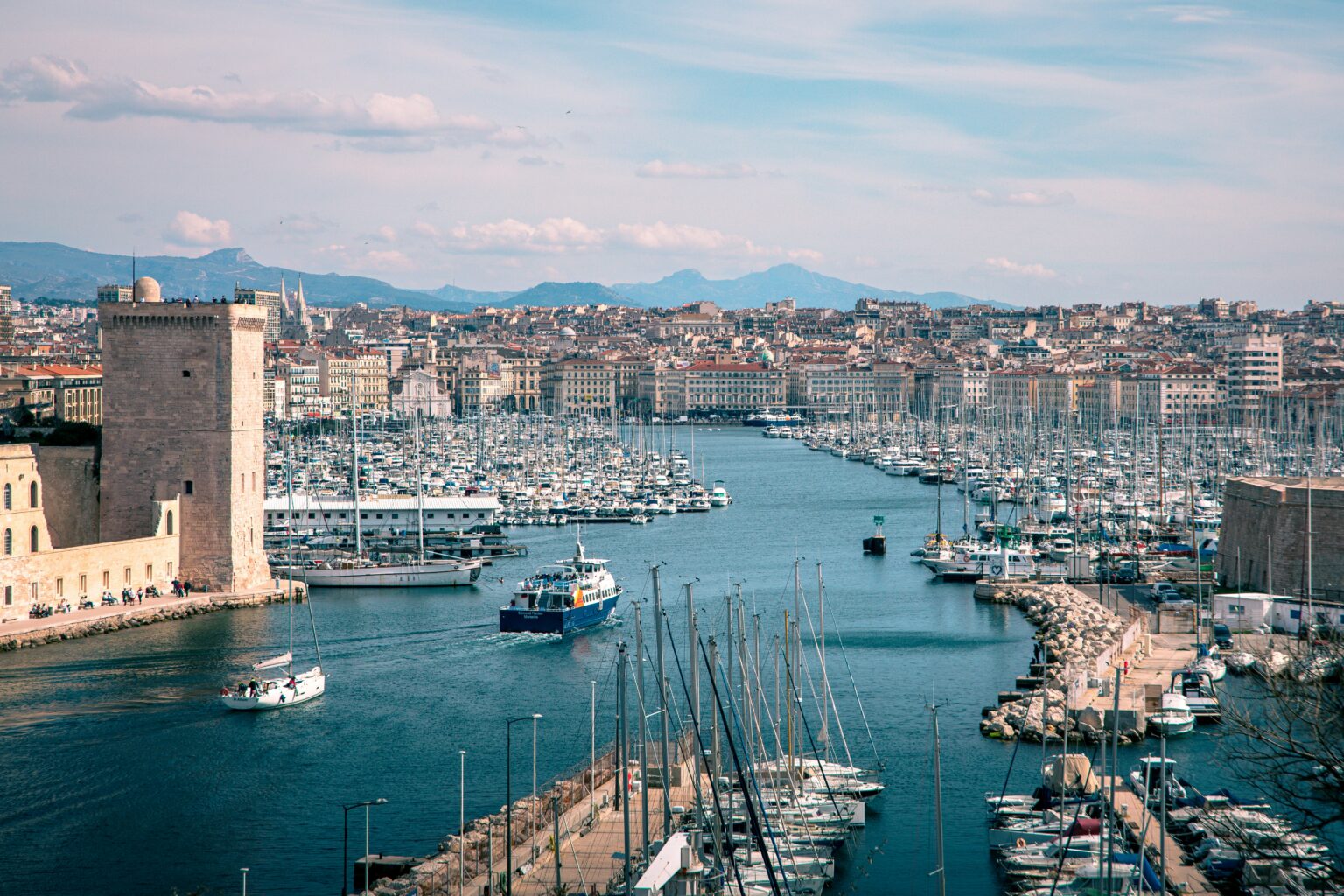

Marseille, like other French cities, is composed of an intricate web of immigrant communities. Armenians, Italians and Jews once found shelter here; now it hosts one of France’s largest North African communities.
Beautiful cathedral church and breathtaking views from its height are a must when visiting Marseille! Don’t miss this experience when in town!
1. Notre-Dame de la Garde
Built atop a hill overlooking Marseille, the extravagant Romano-Byzantine Basilica of Notre-Dame de la Garde stands as a powerful symbol of faith and devotion for the city. Devoted to Our Lady of the Guard – considered an advocate for sailors and fishermen since medieval times – this church rises 160 meters above sea level, becoming an invaluable pilgrimage site.
La Bonne Mere–locally known as the Virgin Mary–sits proudly on top of Marseille’s bell tower, providing stunning panoramic views and making for an instantly recognisable landmark.
Internally, the basilica’s intricate details and ornate decorations are breathtaking. The gorgeous artwork exemplifies Marseille’s maritime history while paying homage to Christian roots of its Christian population. Furthermore, many motifs from Marseille’s naval past such as anchor motifs or models of ships can be found throughout.
At its rooftop terrace, it offers magnificent panoramic views that span from colorful rooftops and bustling port below to panoramic vistas over sweeping vistas of city’s landscape and blue waters below. To get the full experience of this striking landmark, the ideal time is early morning or late afternoon when crowds have dissipated and fully appreciate this captivating landmark.
2. Palais Longchamp
Palais Longchamp is one of Marseille’s iconic landmarks and should not be missed when visiting. Situated at the center of town, this majestic park covers eight hectares with lush green space, museums and sumptuous architecture – not to mention several monuments such as an 18th-century zoo which includes oriental pavilions for giraffes, elephants and bears, plus cages decorated with Turkish tiles! It also serves as home to various monuments that make this palace truly worth seeing.
Built in the mid 19th century to commemorate water arriving on Longchamp plateau from Canal de Marseille, the longchamp fountain stands as an icon of Marseille history and identity. Designed by Henri-Jacques Esperandieu – who also designed Notre Dame de la Garde as part of other major Marseille landmarks such as Place Charles V – this striking monument stands proudly today as part of their history and identity.
At present, Palais Longchamp houses the Museum of Fine Arts and Natural History as well as being listed as a Historic Monument of France. Its surrounding park offers picnicking opportunities while it often serves as the site for cultural events and exhibitions held there.
No entrance fee is charged to enter and explore the gardens of the park; however, admission fees may apply to museums within the palace complex. Guided tours may also be available; it is advisable to inquire with each museum in advance about availability.
3. Musée de la Méditerrannée
Mucem has quickly become an iconic landmark of modern Marseille since opening its doors in 2013. Boasting an ambitious collection that spans the history of Europe and the Mediterranean, its groundbreaking exhibitions showcase this history through stunning contemporary design by Algerian-born architects Rudy Ricciotti and Roland Carta with footbridge access linking it with 13th-century Fort St-Jean for spectacular views over Vieux Port.
The Musee de la Mediterrannee serves as an indispensable resource for scholars and historians, while providing an important forum for discussions of major societal issues through temporary exhibitions. Furthermore, this institution runs ethnographic research programs on European and Mediterranean territories through partnerships with regional or international institutions.
The museum also houses important archaeological and ethnographic collections. Notable among them is the Mandylion, a large icon depicting Jesus Christ made in Constantinople by a workshop producing icons for the Orthodox Church and considered one of the finest examples of Byzantine art. Other major pieces include cuneiform tablets bearing Saint Maximinus II’s name as well as dates for both his consecration and death – one of the key sources for tracing Christianity through Marseille’s history.
4. Palais de la Méditerrannée
Palais de la Mediterrannee Hotel and Casino can be found in the heart of Nice, featuring an Art Deco facade listed as a historical monument. Home to a prestigious casino that hosts events year-round as well as providing luxurious accommodations and world-class amenities, Palais de la Mediterrannee provides luxurious accommodations and world-class amenities.
The Palace opened to great acclaim in 1929 and soon became an emblem of Belle Epoque decadence – becoming a shining beacon of Paris during its golden era. Designed by architects Charles and Marcel Dalmas, the complex soon became an attraction for high society members and celebrities, offering casino gaming, theatre performances and cocktail bars; rooms offering stunning Mediterranean Sea views were all hallmarks of its success.
World War II and Casino Wars put an end to its rise, leading to years of decline. Finally, receivership was declared in 1978, when its stained glass windows were auctioned off along with furniture and decorations sold.
But like an iconic Phoenix, Palais de la Mediterrannee emerged triumphant from its destruction to open back as an elegant and luxurious hotel in 2004. Today it stands as a five-star institution that blends contemporary ideas with grand scale opulence.
5. Notre-Dame-de-la-Garde
Occupying Marseille’s highest natural point, this extravagant 19th-century Romano-Byzantine basilica serves as one of its most beloved symbols and pilgrimage sites. Locals affectionately refer to it as la Bonne Mere (‘the Good Mother’), reflecting its longstanding cultural significance for local residents.
Since 1214, Notre-Dame de la Garde has served as a place of spiritual and physical protection for sailors since it first opened as a basilica. Many believe that Mary, represented by the statue atop its bell tower, watches over Marseille and its citizens while protecting seafarers and merchants – thus inculcating this faith into local culture, leading to many ex-votos over time.
The church can be seen from streets and hills throughout Marseille, making it one of the most recognizable landmarks in France. No matter your interests – art, history or just beautiful views – this must-see attraction should not be missed! Take time to stroll around its exterior and view its mosaics which feature maritime themes in homage to Marseille’s long seafaring past.
6. Musée de la Méditerrannée
Musee de la Mediterrannee, or Museum of Mediterranean History, offers visitors to Marseilles an immersive look into its past. Boasting two buildings connected by an overhead walkway – both old and modern – its exhibits cover every aspect of Mediterranean history from antiquity through today – travelers have given this museum rave reviews as it provides them with a good understanding of culture in this part of France.
The plague outbreak of 1720-1722 was one of the worst ever experienced by Marseille. By this time, it had grown into one of Europe’s premier trading ports with North Africa and Eastern Mediterranean trading routes – meaning its complex yet effective sanitation systems were put to great use to contain and stop disease within its walls.
Musee de la Mediterrannee was opened as part of Marseille’s bid for European Capital of Culture status. Designed by architect Rudy Ricciotti, the museum stands out as a striking white cantilevered structure which seems suspended above the water, drawing visitors in with its beautiful architecture and informative exhibits. Although less famous than its neighbouring batiment le plus imposant de Marseille (Bon Merce), I feel this one stands out as its greatest architectural landmark: beautiful columns and fountains make this stop-off worth visiting!
7. Port of Marseille
Marseille’s port has long been an essential center of Mediterranean and African trade as well as one of France’s main defense points. Your tour starts in Vieux Port (old harbor), one of the world’s largest natural harbors that formed its basis. Take your time strolling its perimeter–lined with lively seafood restaurants and some of Marseille’s oldest structures–while learning about its rich history; including how it first attracted foreigners–largely Muslims–to its shores.
Although commercial docks were moved to Joliette during the 1840s, the vibrant Vieux Port remains an attractive destination for fishing boats, yachts, and pleasure craft. Protected by forts Saint-Jean and St-Nicolas as well as the iconic Transbordeur bridge–built in 1905 but dismantled after World War II–this harbor remains bustling today.
Just beyond the port, explore Panier district – Marseille’s working class neighborhood. Its organic cadaster, featuring 17th and early 18th century classical extensions laid regularly over time, stands in stark contrast with the industrial landscape surrounding the port. Vincent de Paul frequently wrote letters in which he would refer to his interactions with local people who resided here; today it continues to see waves of immigrants arrive each year.
Trip-ready gear from Amazon
As an Amazon Associate, grandgo.com earns from qualifying purchases. Links below are affiliate links — clicking them may earn us a small commission at no extra cost to you. Prices and availability are shown on Amazon.co.uk.
- Compact rain jacket packable — Paris weather is fickle.
- French phrasebook Berlitz — Essential French for travel.
- Waiters friend corkscrew Laguiole — For every French wine picnic.