



Quick Answer
Zurich is approximately 2,040 years old: Roman origins (15 BC): founded as Turicum customs station by Romans during Emperor Augustus’s reign. Trading post on Limmat river route to Italy. Medieval town (10th century): granted town rights by Holy Roman Empire. Free Imperial City (1218): independent jurisdiction within Holy Roman Empire. Joined Swiss Confederacy (1351): 5th canton to join. Reformation (1519): Huldrych Zwingli began Swiss Reformation at Grossmünster. Industrial era (19th c.): textiles + silk + machinery. ETH founded 1855. 20th century: Dadaism birthplace (1916) at Cabaret Voltaire. Lenin lived Spiegelgasse 14 (1916-17). Modern era: global banking center + 5+ million annual visitors. Oldest building: Grossmünster (12th century) + Lindenhof Roman remains. Population growth: ~5,000 (1500) → 25,000 (1800) → 440,000 (2026).
Roman origins — Turicum (15 BC)
- Founded 15 BC: Roman customs station on Lindenhof hill.
- Name Turicum: Celtic origin meaning “(place of) Tor” (god) or “Turic” tribe. Inscription “STA(tio) TURICEN(sis)” found.
- Roman trading post: on Limmat river — strategic route between Lake Zurich and the Rhine.
- Tomb inscription discovery: first known mention of Turicum from 2nd-century AD Roman tomb.
- Lindenhof Hill: Roman fort + customs station — visible foundations preserved today.
- Roman bath: archaeological remains under modern buildings.
- Roman cemetery: located near today’s Bahnhofstrasse.
- Decline of Roman rule: 5th century AD — Alemanni Germanic tribes took over.
- Alamannic settlement: Germanic-speaking foundations of Swiss German culture.
Medieval era — town to Free Imperial City
- 9th century: Fraumünster Abbey founded by Louis the German (853) for daughters of Charlemagne descendants.
- 10th century: Zurich became town under Carolingian Empire.
- 1218 — Free Imperial City: direct status under Holy Roman Empire, no feudal lord.
- 13th-14th century: guild system established + craftsman + merchants gain power.
- 1351: joined Old Swiss Confederacy (5th canton). Started Swiss independence movement.
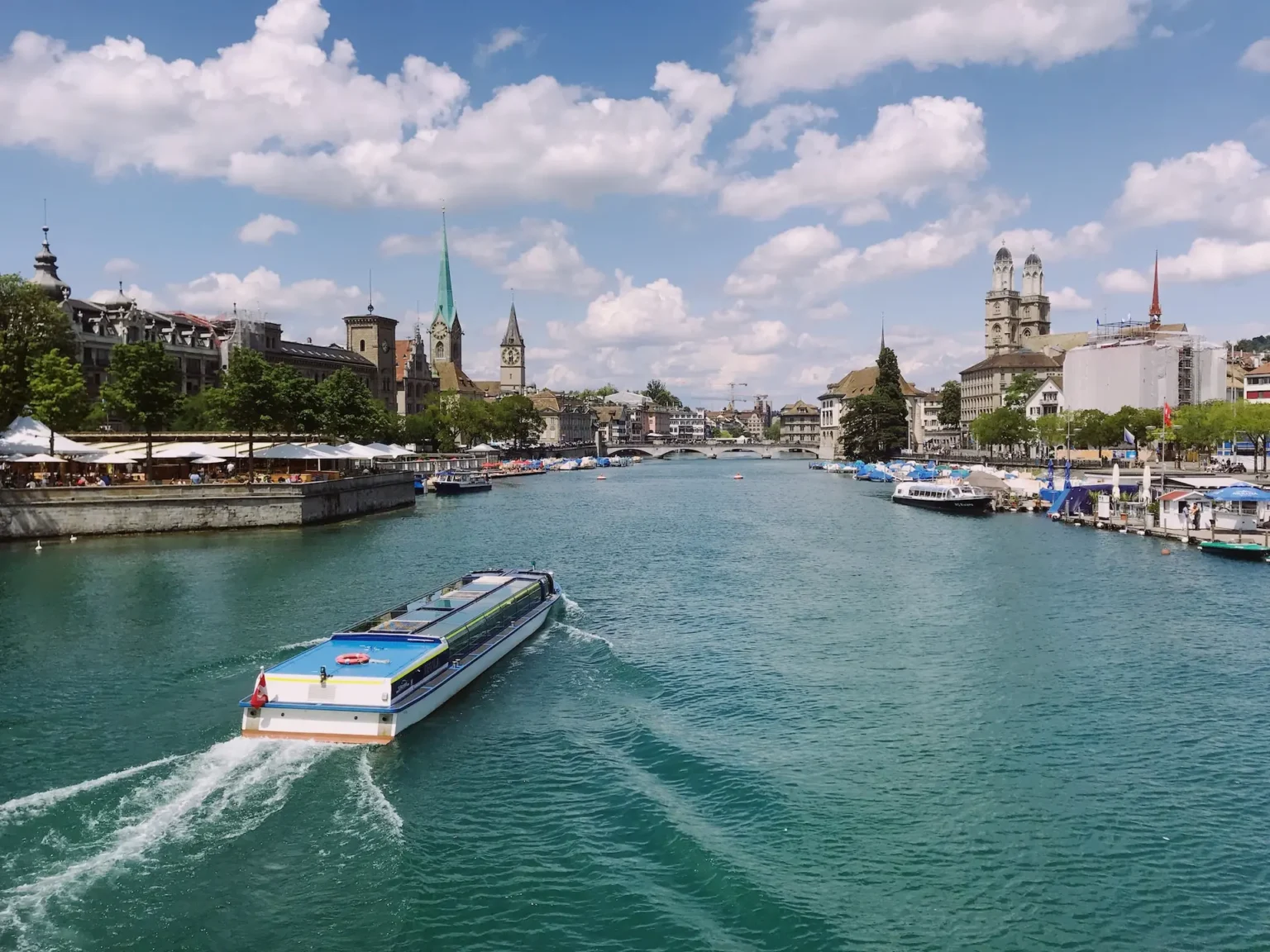
- Grossmünster: 12th-century Romanesque cathedral — Zurich’s symbol.
- Fraumünster: 9th-century convent.
- Lindenhof viewing: medieval town wall visible from hilltop park.
- Niederdorf: medieval cobblestone quarter still preserved.
- Spiegelgasse: oldest preserved street in Zurich.
- Rathaus (Town Hall): 1690s Renaissance — replaced earlier medieval building.
Reformation (1519) + Zwingli
- Huldrych Zwingli (1484-1531): Swiss Reformer who started Reformation at Grossmünster 1519.
- Zwingli’s Theology: stricter than Luther + emphasizing Bible alone + opposed images + simpler worship.
- 1523: Zurich Council adopted Zwingli’s Reformed Church.
- 1531: Zwingli killed at Battle of Kappel between Protestants + Catholics.
- Iconoclasm: Zurich churches stripped of statues + paintings + most religious art.
- Calvinism legacy: Calvin trained at Geneva (also Switzerland) — both Swiss Reformed.
- Reformed Protestant tradition: Zurich = world center of Reformed Christianity.
- Zwingli Museum: in Grossmünster — life + works of reformer.
- Religious refugees: Zurich welcomed many Reformation refugees.
- Today: 25% Reformed, 25% Roman Catholic, 50% other/none.
Industrial Revolution + modernization
- 18th-19th centuries: silk + textile industry transformed economy.
- 1830s: Industrial revolution arrives. Factories around Sihl river.
- 1847: Switzerland’s first railway Zurich-Baden.
- 1848: Swiss Constitution + modern federal state.
- 1855: ETH Zurich founded — Switzerland’s top technical university.
- 1871: first cable car (Polybahn near ETH) opens.
- Late 19th century: Bahnhofstrasse laid out as modern shopping street (1864).
- 1920s: textiles decline, banking + insurance rise.
- 1916: Dadaism founded at Cabaret Voltaire (Spiegelgasse 1).
- 1916-17: Lenin lived at Spiegelgasse 14 — fled to Russia for Revolution.
- WWII: Switzerland remained neutral.
- 1945+: banking secrecy + financial dominance emerge.
Modern Zurich (1950+) + today
- 1950s-60s: economic boom, banking expands.
- 1971: Swiss women won full voting rights.
- 1980: Jugend riots (youth riots) for autonomous spaces.
- 1981: Zurich women fight HIV/AIDS sex worker rights.
- 1992: heroin pioneer treatment program — Switzerland’s drug policy reform.
- 2000s: Crypto Valley Zug nearby emerges + tech sector.
- 2014: Hauptbahnhof renovation completed.
- 2023: Credit Suisse collapse + UBS takeover.
- 2026: 440,000 population + 5+ million annual visitors.
- Population history: 5,000 (1500) → 25,000 (1800) → 105,000 (1900) → 440,000 (2026).
- Cultural status: world’s top liveable cities consistently.
- UNESCO: nearby Rhaetian Railway + parts of Lavaux + Müstair monastery.
Frequently Asked Questions
How old is Zurich?
Approximately 2,040 years old. Founded as Roman Turicum customs station 15 BC. Continuously inhabited since.
Roman ruins in Zurich?
Lindenhof Hill has visible Roman fortifications + tomb inscriptions. Roman bath remains under buildings. Originally founded 15 BC.
When did Zurich join Switzerland?
1351 — Zurich was 5th canton to join Old Swiss Confederacy. Helped start Swiss independence movement.
Zwingli Reformation Zurich?
Huldrych Zwingli started Swiss Reformation 1519 at Grossmünster. Adopted by Zurich Council 1523. Killed Battle of Kappel 1531.
Oldest building Zurich?
Grossmünster (12th century Romanesque) + Fraumünster (9th-century convent church). Lindenhof has Roman foundations.
Why did Lenin live in Zurich?
Lenin lived at Spiegelgasse 14 (1916-17). Niederdorf + Zurich offered political refuge. Returned to Russia April 1917 for Revolution.
Recommended on Amazon
As an Amazon Associate, grandgo.com earns from qualifying purchases. Links below are affiliate links — clicking them may earn us a small commission at no extra cost to you. Prices and availability are shown on Amazon.co.uk.
- Lonely Planet Switzerland — Zurich history.
- History of Switzerland book — comprehensive.
- Comfortable walking shoes — historic walks.