


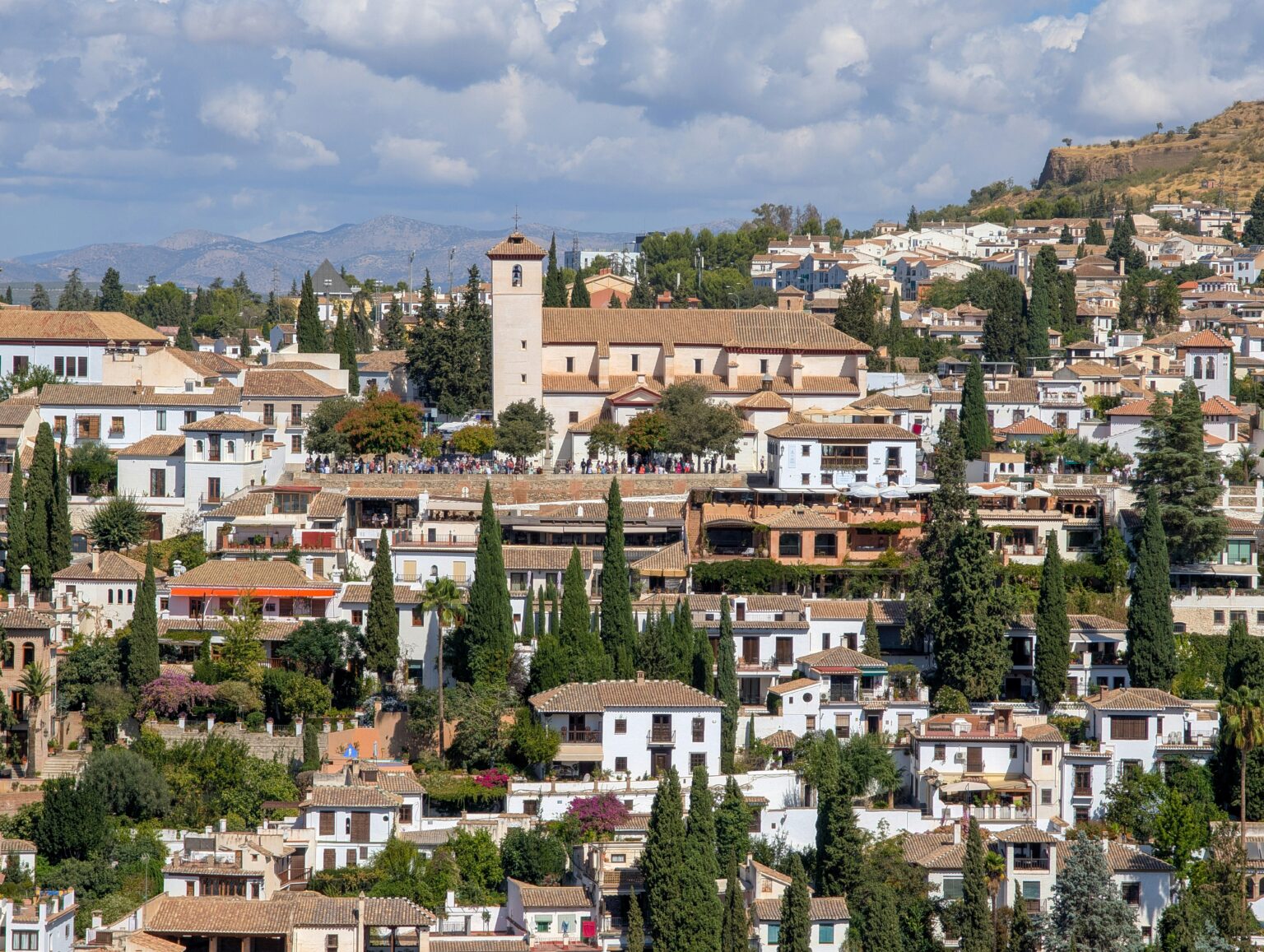

Granada derives its name from “pomegranate,” and you’ll see this symbol everywhere from gates to cathedrals. Catholic Monarchs used this emblem as their sign of final victory against Al-Andalus’ Moorish rulers.
Street music in Granada is an unforgettable experience, from classical cellists playing their instruments in plazas to Balkan accordion ballads mixed with French rap melding seamlessly together. Furthermore, this city also features flamenco performances.
The Alhambra
The Alhambra is an extraordinary complex of palaces, gardens and other structures encased by fortified walls. Built by Arabs who controlled Granada during medieval times, today it stands as an iconic attraction of Spain and is listed on UNESCO World Heritage. Part of its allure lies in its ability to connect us with history while remaining beautiful today.
The Alhambra has always been shrouded in mystery and symbolism, growing into an iconic example of Islamic architecture over time. Starting life as a simple fort in the ninth century, its transformation during Nasrid rule into its monumental presence that dominates Sabika Hill today was nothing short of extraordinary.
Muhammad I, known as Ibn al-Ahmar, began construction of this city on its current location in 1238. His aim was to construct a royal city similar to that of Abdallah Al-Zahra near Cordoba while also protecting his royal residence and surrounding Granada plain (vega).
In the 13th century, this project reached its apex under Yusuf I of Granada and his son Muhammad V of the Nasrid dynasty; they are responsible for commissioning many of the buildings which constitute Alhambra today.
Granada was rocked by war during this era. Historically, it served as the seat of Islamic Moorish sway until 1492 when Ferdinand II and Isabella conquered it during their Reconquista campaign.
The Alhambra was established as an original citadel in 13th-century Spain. Today its remaining walls provide the base for palaces, baths and other structures that make up its main enclosure, including many others such as Alhambra Museum showcasing Islamic art.
Alhambra palaces and courtyards boast beautiful fountains and waterworks, such as The Palace of Lions with its exquisite carved-stone fountain with arched openings. Exploring this complex will be an exquisite pleasure that you will want to spend hours doing so!
The Alcazaba
The Alcazaba is an incredible medieval fortress with Moorish elements that harkens back to Granada’s Muslim past. Built during the 11th century as a residence for its rulers, you’ll find it on top of a hill near Gibralfaro Castle – it remains one of the finest examples of Moorish architecture in Spain today.
As soon as you arrive at the entrance, you will notice special walkways have been set up so that visitors can move safely around the ruins without risk of damaging them. This allows visitors to enjoy close up the beauty of these Roman relics while enjoying panoramic city views from Teatro Romano – an eye-catching structure used for many purposes over the years.
To gain the full experience of this astonishing fortress, I suggest beginning your visit here. At this small interpretation center you can buy tickets and gain entry into the complex; from there you’ll begin climbing through its walls into courtyards filled with fountains, trees and intricate arches; these spaces add even more charm!
Once inside, once through the first gate of the fortress, you’ll arrive at Plaza de Armas (Weapons Square) which was where cannons were installed following Christianity’s reconquest, continuing your way to Alcazaba Palace area.
Once inside, once you arrive at the Alcazaba you’ll discover it was once home to many houses; hence its nickname of “barrio de las viviendas.”
The Alcazaba was constructed by King Badis of the Zirid dynasty. Under Almohad Caliphate and Nasrid Kingdom of Granada rule, various renovations took place, particularly to its interior which was altered and converted into a palace residence for Sultan Nasrid I himself. Outer walls featured towers as protective barriers while its inner part served as his palace residence.
The Cathedral
The Cathedral is one of Granada’s major draws and an exquisite example of Renaissance architecture. Its stunning exterior is graced with intricate sculptures and reliefs depicting Christian faith – setting an impressive scene for what awaits within.
When the Cathedral was completed in Granada and Spain at large, its construction symbolized Christianity’s triumph over Islam. Built on the former site of its central mosque which had to be demolished to make way for it, its construction marked part of Reconquista (or Christian reconquest).
The Cathedral was originally designed by several different architects. Enrique Egas was initially responsible, who excelled at florid late Gothic design but unfortunately succumbed shortly after laying the foundations. Subsequently, Diego de Siloe took on the challenge of building a Renaissance cathedral with Gothic foundations; no simple task!
After 181 years since beginning construction in 1704, the Cathedral was finally finished after years of struggle and trial-and-error by its builders and workers. Today it stands as an incredible testament to Spanish Renaissance architecture as well as to their dedication.
Inside the Cathedral you’ll discover an outstanding collection of religious art. The stunning crucifix at the center of the altar stands as an impressive centerpiece while choir stalls showcase the craftsmanship of woodworkers who created them. Additionally, the Cathedral serves as the burial site of Queen Isabella and King Ferdinand.
Apart from its cathedral, there are various smaller chapels and shrines within the church that are worth seeing. Of note is Capilla Mayor with its elaborately carved wooden choir stall from 17th-century Europe that dates back to Capilla Mayor itself; also interesting is Tabernacle which was constructed from serpentine marble from Sierra Nevada covered with silver covering.
The Church of Santa Ana
As is the case with many churches in Casco Antiguo, Santa Ana Church has been mostly ignored by donors and the Archdiocesan Committee Friends Churches despite possessing numerous features typical of churches in its locale such as its large front in wavy Baroque style and pyramid-shaped tower, which echoes those seen at Metropolitan Cathedral of Panama.
The Church of Santa Ana was constructed during the late eighteenth century on top of an earlier and smaller late sixteenth-century structure for which few records survive. Its design served as an example for other churches within the colony, including one at Santa Cruz de Tenorio that was inspired by Santiago’s church.
Santa Ana Church was intended to become the focal point for the village that would grow up around it, facing east with more or less parallel house blocks behind it and a wide thirsty riverbed to its south; Sanz de Lezaun described this layout as singular within all of colony.
To mark the significance of this new church, an elaborate bell from London was installed in its back tower, while a replica reredos of San Felipe was constructed – complete with its famous bell. Additionally, one Laguna santero, though perhaps not quite as talented as his master santero from San Felipe, redecorated the main altar screen and replaced an older statue of St. Anne with an image depicting St. Anne that still hangs from its reredos today.
An older santero created two oval paintings on the side panels of his reredos that I don’t know why, though I suspect they represent some sort of biblical story about mentoring or father figures helping a boy navigate life’s challenges.
Church of Santa Ana has seen many influential priests and lay leaders over its long history, such as Marcial Aguiluz Orellana who was born at La Lindora hacienda and later served as one of its revolutionary leaders to overthrow dictatorships in Honduras and El Salvador before coming to Santa Ana where he led revolutionaries that overthrew Jose Figueres Ferrer backers in 1948 and later led a guerrilla movement against Rafael Calderon Guardia’s dictatorship in 1949.
Trip-ready gear from Amazon
As an Amazon Associate, grandgo.com earns from qualifying purchases. Links below are affiliate links — clicking them may earn us a small commission at no extra cost to you. Prices and availability are shown on Amazon.co.uk.
- Wine tasting glass Riedel — Rioja + Ribera tastings.
- Spanish phrasebook Berlitz — Essential Spanish for travel.
- Sun hat wide-brim women men — Andalusian summer necessity.