


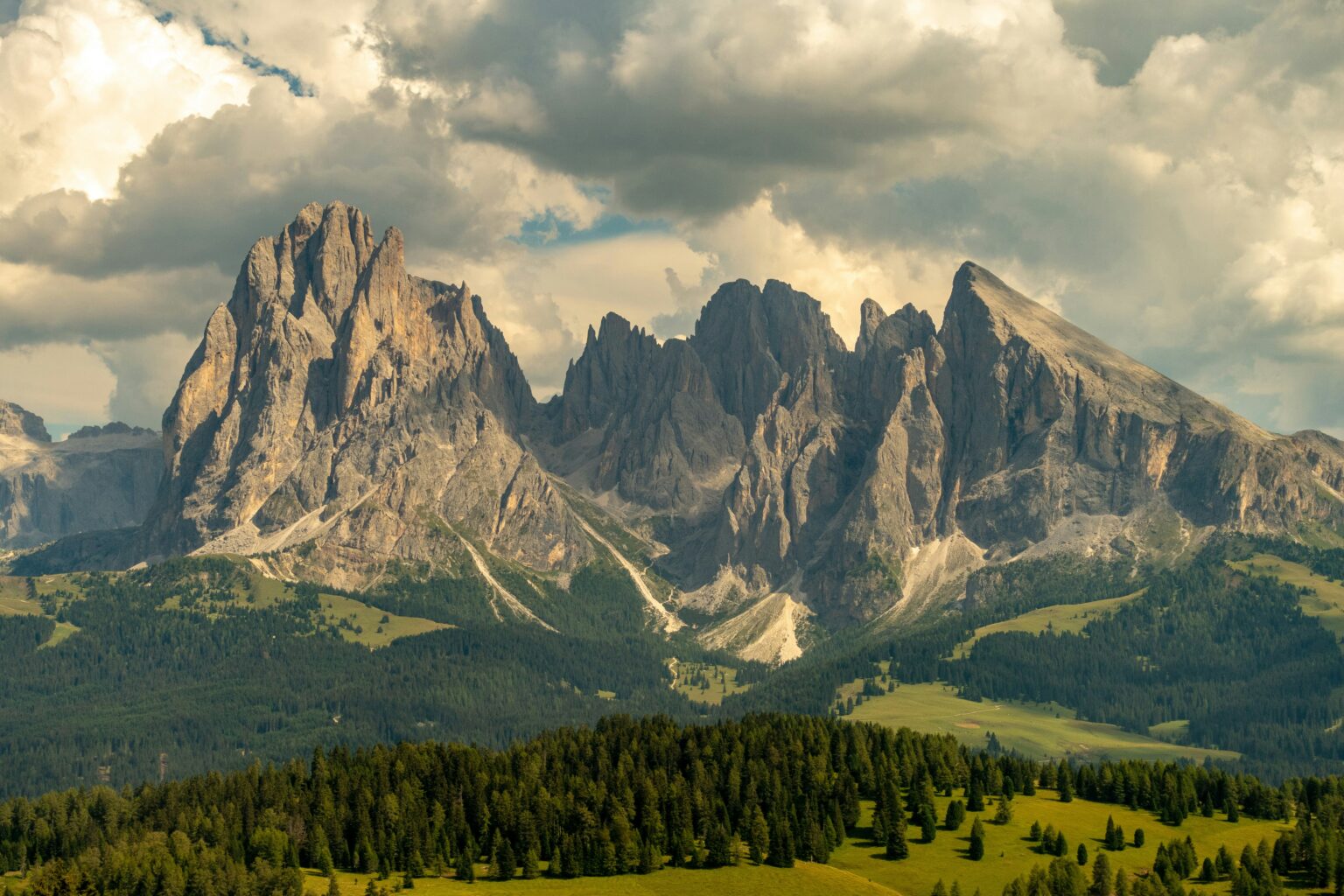

The Dolomites is an exceptional mountain area offering something for everyone – ski or snowboard in winter, hike, climb and mountain bike in summer!
Dolomites’ impressive rock formations are fossilized seabed barriers that once isolated a tropical seabed from the rest of the planet.
These islands were created from the accumulation of shells and coral skeletons in the Tethys Sea.
Geological History
The Dolomites are an extraordinary geological landscape with features of global significance that stand out among any other landscape. Their dramatic scene was formed over an immense timeframe of around 280 million years ago. At that time, Europe and Africa were still joined as one continent, Pangaea. Their collision caused processes which led to the formation of sedimentary rocks that eventually formed mountains. Dolomites mountains were subject to relatively mild tectonic deformation compared with other mountain ranges, preserving original relationships among rock layers in an unparalleled series of rock formations such as peaks, towers, pinnacles and some of the highest vertical rock walls on Earth. This resulted in stunning multifaceted rock formations such as pinnacles, towers and some of the highest vertical walls around.
Geological heritage is what sets the Dolomites apart and initially captured travellers and artists’ imagination in the nineteenth century. Diedonne-Silvain-Guy-Tancrede de Gvalet de Dolomieu published his report about an unusual limestone type he encountered on his travels – white rocks with crystals composed of calcite and aragonite that did not react with acid, giving this kind of rock its name: dolomite.
Dolomitic limestone forms an array of varied natural landscapes in the Dolomites, from towering peaks and towers to smooth slopes, shallow valleys and steep gullies. Cliffs, rock fissures and screes are home to plants adapted for cold and dry conditions; many species endemic to these regions. On the other hand, meadows offer damper environments that are suitable for damper growth conditions.
Subsidence allowed an ancient sea to once more infiltrate this region during the Middle Triassic, leading to deep carbonate deposits known as fossil reefs in the Dolomites – these fossil reefs serve as important testaments of marine organisms’ evolutionary journey and ability to build complex structures.
Fossils
At the time of their formation in Permian and Triassic times, the Dolomites existed within an expansive tropical sea dotted with coral reefs similar to what can be found today in Maldives. Over time, small rocky islands became larger until eventually they started rising above sea level – marking the beginning of their transformation into mountains.
As part of this process, land was compressed. Over time, nature took over by growing trees, shrubs, and grass that once covered sea floor – giving rise to Dolomites that look much more alpine-like than their counterparts elsewhere in Europe and worldwide. This makes the Dolomites one of a kind when it comes to landscape and topography!
After the end of Carboniferous period, another period of subsidence occurred here and caused sea levels to withdraw once again, but not before covering a vast series of fossil reefs (carbonate rocks with deep layers known as fossil reefs) found throughout Dolomites (for instance in Marmolada and Latemar regions).
These were once home to marine creatures such as sponges, bivalves, fishes and reptiles; many fossils have been exquisitely preserved – such as one belonging to Nothosaurus (an extinct land reptile similar to dinosaurs).
The Dolomites are not only stunning natural landmarks; they are also an invaluable window into our planet. That is why all nine sites that comprise the Dolomites have been designated World Heritage Properties.
Dolomites offer an extraordinary diversity and emblematic array of morphological features connected with earth crust movement, particularly that caused by disintegrating dolomite masses with multiple colors and shapes, monumental peaks with less steep slopes, mountain crags, glaciers, forests and valleys – each unique landscape featuring stark contrast between areas covered with snow or vegetation and those without. They therefore illustrate a particularly significant chapter in Earth history through an eye-catching and consistent display.
Colours
Dolomites landscape is famed for its unparalleled beauty, in part due to their distinctive rock colour. Their light hue stands in stark contrast with the lush meadows, forests, and open valleys below them; and their rock cliffs, fissures, and screes host an abundance of plant species adapted to harsh mountain environments. As home to numerous microhabitats the Dolomites serve as an invaluable biogeographic hub that sustains both animal species as well as plant varieties.
Dolomite (CaMg(CO3)2) is an iron-bearing carbonate mineral composed of calcium and magnesium carbonates with perfect three-directional cleavage that forms rhombohedra, typically found as translucent to transparent crystals or opaque masses. Dolomite can have pink, yellow, white or gray colors depending on its iron content; it dissolves readily in hot dilute acids but not cold ones.
Due to their unique geological makeup, the Dolomites stand out at sunrise and sunset for their spectacular pink hue, known as enrosadira in Ladin. While this phenomenon occurs globally on limestone mountains, its striking presence can only be seen more readily due to the unique formation of Dolomites mountains.
The Dolomites are world-renowned for their dramatic color and shape, but also hold an alluring allure that draws people in from around the globe. Hiking through them takes you past jagged mountains, alpine terrain, beautiful lakes and atmospheric fog; their charming villages boast charming homes decorated with colorful geraniums or petunias; while their famous larch trees create a spectacular visual backdrop during autumn hikes.
Lago Federa is one of the Dolomites’ premier photography locations, but unfortunately is also very crowded with tourists; I had to fight through hordes of tourists all morning when we hiked there. Still, there are numerous spots worth exploring to discover your own personal photography spots in these mountains; all it takes is patience and hard work!
Shapes
The stunning landscape of the Dolomites owes its unique beauty to both structural and climatic factors. Structurally, they’re distinguished by cliffs in breathtaking forms such as pinnacles and spires, steep slopes, rocky ledges that span valleys, and steep slopes reminiscent of terrain found elsewhere on Earth. Climatically speaking, erosion processes such as avalanches, frostbite, melting rocks and sediments, melting glacial processes, melting rock layer deposits into rivers… and finally, karstification processes contribute further enhancing their unique appeal.
The Dolomites are one of Italy’s nine UNESCO World Heritage sites and boast unique geological features that set them apart worldwide.
In the Dolomites, limestone walls formed through weathering and erosion are juxtaposed against bare talus deposits, forests and meadows to form breathtaking mountain panoramas that distinguish the Dolomites from other Alpine massifs. Their striking rock colours give rise to breathtaking mountain panoramas that stand out against others such as other Alpine massifs; furthermore their iconic mountains boast towers, needles, needles shaped like pinnacles as well as seemingly hand crafted rock cliffs which seem as though sculpted by giant hands!
These striking shapes are the result of many processes that took place over millions of years. The Dolomites once served as a marine archipelago; fossil discoveries attest to this period. As supercontinent Pangea submerged beneath the sea, life evolved and developed in different ways; small organisms, such as corals and sponges adapted by building higher barriers that eventually fossilised into massive Dolomite mountains visible today.
Dolomites mountains are known for their diverse plantlife. Beginning early summer, Dolomite meadows bloom with colorful crocus, narcissus, clover and saxifrage flowers. Chamois and marmots as well as numerous birds such as hawks and vultures inhabit these hillsides as well.
The Dolomites, commonly referred to as the Pale Mountains, due to their white rocks reflecting sunlight and emitting stunning hues of pink, red and purple at dawn and dusk, is commonly referred to as Pale Mountains. These extraordinary properties can be attributed to double calcium carbonate bedrock found throughout these mountains; French naturalist Deodat Gratet de Dolomieu made this name official upon discovering its properties in 1791.
Trip-ready gear from Amazon
As an Amazon Associate, grandgo.com earns from qualifying purchases. Links below are affiliate links — clicking them may earn us a small commission at no extra cost to you. Prices and availability are shown on Amazon.co.uk.
- Anker portable charger 20000mAh — All-day phone battery.
- Lonely Planet destination travel guide — Trip planning essential.
- Universal travel adapter — 150+ countries covered.